Sunday, January 31, 2010
Stealing from Facebook again...
"What the lobbyists will not tell you: According to the Kaiser Family Foundation, Va Insurance Premiums are below the national average despite having a higher number of mandates. In other words, mandates do not directly corellate to high insurance premiums. HB 303 will actually save Virginia money, if passed, due to ...savings expected in Special Education.


Sunday, January 24, 2010
From Dlisted...
Okay, don't let the title fool you... it is really a great, albeit sassy article about revenge from the woman who was the possibly unknowing mistress of the president of Oracle. It is really funny, thus shared. Because since I can't sleep tonight, I need a good laugh.
Hot Slut Of The Day!
Posted using ShareThis
Hot Slut Of The Day!
Posted using ShareThis
Saturday, January 23, 2010
Good news from Facebook!!!
From the Virginia Autism Project - there are 10 autism bills this year, including another one from Delegate/Rock Star Bob Marshall:
"House Bill 34 (HB34) provides the most comprehensive services by mandating health insurance coverage for autism spectrum disorders in individuals under the age of 21. Thank you Delegate Marshall for your support!"
Intellectually, I know the other one stands a better shot, but emotionally I can have a little hope that maybe, just maybe...
Word to Live By
"All I ask of you is one thing: please don't be cynical. I hate cynicism -- it's my least favorite quality and it doesn't lead anywhere. Nobody in life gets exactly what they thought they were going to get. But if you work really hard and you're kind, amazing things will happen."
Conan O'Brien
Conan O'Brien
Friday, January 22, 2010
A Great Article: Patient Money: A Road Map to Help Parents Deal with the Financial Burden of Autism
Dealing With the Financial Burden of Autism
WHEN Jeff Sell’s twin sons were found to have autism 13 years ago, he, like so many other parents in the same situation, found himself with a million questions: Will my children be able to function? What are the best treatments and where do I find them? How will this affect the rest of my family?
And besides those monumental worries, Mr. Sell kept asking himself another fundamental question as he began the long string of doctor and therapist visits with his sons: “How in the world am I going to pay for all this?”
Autism trends, treatments and therapies routinely make headlines. Often overlooked, though, is the financial burden for many families with autistic children.
Treatment is extremely expensive. Direct medical and nonmedical costs can add up to as much as $72,000 a year for someone with an extreme case of the disorder, and even $67,000 a year for those on the lower end of the spectrum, according to a study from the Harvard School of Public Health.
That figure includes medical costs like doctor visits, prescriptions and occupational and speech therapy, as well as expenses for things like special education, camps and child care, said Michael Ganz, the author of the study, who is now a health care consultant.
“It can cost $3.2 million to take care of an autistic person over the course of his or her lifetime,” the study said.
More families are grappling with the disorder than ever before. One of every 110 8-year-old children in the United States has been diagnosed with autism — and one of every 70 boys, according to the latest survey from the Centers for Disease Control and Prevention, released last fall. That is up from one in 150 children in a comparable report released in 2007.
“The numbers are just amazing,” said Pat Kemp, executive vice president of the advocacy group Autism Speaks, “Unless we attack this like a national health crisis, we’re going to have a huge economic crisis on our hands.”
Certainly families feel the financial strain. Many health insurance policies do not cover autism treatments, while those that do often have severe limits. And there is very little government or private financial assistance available.
In many cases these children will need assistance all their lives, Mr. Ganz points out. Making sure there is money for the future is something else parents worry about.
When his sons received their diagnosis, Mr. Sell was practicing personal-injury law in Texas, and he began paying for many of their treatments from his own income and savings. In 2005, as he became more involved in autism issues, he joined the staff of the Autism Society of America in Bethesda, Md., where he is now a vice president.
His sons are now 15. One, Joe, is talkative and considered “high functioning.” The other, Ben, is nonverbal with profound autism.
“What works for one child doesn’t necessarily work for the other,” Mr. Sell said. “So we’re talking about finding and paying for twice as many treatments.”
In the early years, the Sell family had some autism coverage under Mr. Sell’s health insurance. But claims for certain therapies, tests and treatments were often denied. “I was very aggressive about appealing those denials, and I often won,” Mr. Sell said.
But even with coverage, Mr. Sell found he needed to pay enormous amounts out of pocket to come close to giving his sons the 20 to 40 hours of behavioral therapies each week that were often recommended. (Eventually, as discussed below, Mr. Sell was also able to obtain financial assistance through a special part of the Medicaid program.)
Although direct financial support may be scarce and hard to obtain, there are several autism information and advocacy groups that routinely help parents navigate financial hurdles. Here is a road map parents can use to get started.
CHECK YOUR INSURANCE Coverage for autism treatments is still far from common, but it is improving. Some large employers offer policies that cover treatment, and 15 states have passed laws mandating at least some autism-related coverage. The Autism Society’s Web site lists the relevant states. (That section of the site is still under construction, but you can scroll down to see the states.)
In addition, Maine and New Hampshire both have legislation pending that could pass soon, Mr. Kemp said.
If you do have coverage, watch for limitations. Because treatment for autism is so individualized, there are few uniform standards or protocols for insurance companies to follow. That means parents often have to argue that a certain therapy or treatment is necessary. Also, be sure to check any caps on treatment, Mr. Sell warns. What may look generous — say $36,000 a year — can be spent quickly. Or there may be limits on how many sessions of a particular type of therapy will be paid for each year.
And you will want to coordinate your insurance coverage with the services you may be receiving from your child’s school. If an occupational therapist sees your child regularly in school, for example, you may want to save your insurance dollars for social interaction therapies.
In addition, you may need to be especially aggressive about coverage for some medical conditions. Gastrointestinal problems, for instance, are extremely common in autistic children.
Mr. Sell found himself fighting for such coverage for Ben, his nonverbal son. The insurance company had denied the claim for gastrointestinal testing, saying that because Ben’s behavior problems were related to autism, the testing was not covered.
Mr. Sell, convinced Ben was in pain and could not tell anyone what was wrong, appealed and won. The tests showed that Ben had ulcers and lower-intestine problems that still occasionally flare up and require treatment.
MEDICAID WAIVERS Some states offer Medicaid coverage for children with autism without taking the family’s income into account — only the child’s diagnosis. This is usually reserved for fairly serious cases but is worth exploring, Mr. Sell said.
“This was a godsend for us,” he said. The waiver, he said, allows families access to services that private insurance won’t cover and that they wouldn’t be able to afford otherwise.
With the waiver, Mr. Sell was able to get more home-based speech and occupational therapies for his sons to supplement the sessions they receive at the public school they both attend. Medicaid also covers recreational therapy during which a specialist takes Ben and Joe on hikes and other outings, giving the parents some downtime.
To see if your child is eligible for a Medicaid waiver, go to the Centers for Medicare and Medicaid Services Web site and click on your state.
Because Medicaid is one of the few government lifelines available, waiting lists for waivers can be extremely long. Mr. Sell, for example, waited nine years to get waivers for his sons.
“Just go ahead and get on the list and try not to be too discouraged,” advised Mr. Sell. “Many states are moving faster now.”
GO LOCAL Many autism advocacy organizations, including Autism Speaks and the Autism Society of America, are affiliated with local chapters throughout the country. In addition, most states, counties, towns and cities provide lists of local autism resources and support groups.
It is people in the local groups who will know all the resources available. They can also help you keep up with the latest research, so you don’t spend time and money chasing the many unsubstantiated “cures” out there. They will also have lots of practical advice, like which dentists, optometrists and even barbers are good with autistic children.
“You think going to the barber is no big deal?” Mr. Sell asked. “Just try it with an autistic child.”
OTHER RESOURCES A handful of organizations like Easter Seals and the National Autism Association offer financial help to struggling families. Autism Family Resources and United Healthcare Children’s Foundation also offer grants to pay for autism treatments.
Monday, January 18, 2010
Wednesday, January 13, 2010
Virginia Tries Again... Sort of... HB 303...
| HB 303 Health insurance; mandated coverage for autism spectrum disorder. |
Health insurance; mandated coverage for autism spectrum disorder. Requires health insurers, health care subscription plans, and health maintenance organizations to provide coverage for the diagnosis and treatment of autism spectrum disorder in individuals from the date of diagnosis until they reach 10 years of age. This requirement does not apply to individual or small group policies, contracts, or plans, and will not apply to the state employees' health insurance plan until July 1, 2015.
...So if you happen to be under the age of the ten when this passed, you are in luck. Jimmy and whole bunch of other kids like him: too late for you, you aren't worth helping, you aren't worth medical treatment or care. The autism lobbyists are trying to pump parents up to call their delegates and I do think early intervention is crucial, but are we going to put an expiration date on children? I guess all the legislation does to some degree, as treatment is focused on minor children. Six, eight, ten... it seems arbitrary to me. I don't think I can support this legislation.

Tuesday, January 12, 2010
Thursday, December 31, 2009
An Actual Comment I Got About Autistic Kids
I have had too much time on my hands with the snow days so I commented on an article in a newspaper. I didn't realize there was a direct message function, so this was forwarded to my e-mail. The comment that he made in his post suggested giving autistic kids guns and ammo if they couldn't be institutionalized. The editor has since removed the comment.
I need to get back to work. No more holidays, no more snow days. I have too much time on the Internet with too many people who have entirely too many people who have too much time and opinions. Starting now... going to clean the guest room.
"I just want to say I don't mean to hurt anyone's feelings over this issue. I just say what is on my mind and sometimes the truth is hurtful to some. I applaud the devotion and dedication it must take to raise an autistic child, but it's just my opinion that they should be institutionalized and the school tax burden that they cause to skyrocket would deminish. It is no doubt the most difficult thing to ever do, to part with such a child. Tell me why people take them to restaurants to disturb somebody elses peaceful meal?"
I need to get back to work. No more holidays, no more snow days. I have too much time on the Internet with too many people who have entirely too many people who have too much time and opinions. Starting now... going to clean the guest room.
Tuesday, December 29, 2009
What Happens When Autistic Children Become Adults
From the Autism Learning Felt blog. What is most stunning in this entry, in one Florida survey, 74% of autistic adults want to work, but only 19% have the opportunity. The government and communities aren't looking ahead to the future for these kids. Parents... we are just trying to manage the day to day. It also mentioned that ugly institutionalization word again. No job, no group home apparently. I don't want an institutionalized life for my son. He deserves more. I want more. I didn't bring him into to the world for this.
Saturday, December 26, 2009
U.S. Senate Passes Health Care Reform Bill Containing Provision For Autism Insurance Reform and Cures Acceleration Network
Does "essential benefits packages" mean nationally mandated? Does this mean we can stop fighting state by state? Does this mean Jimmy will get a chance at the care he deserves even though he lives in Virginia?
U.S. Senate Passes Health Care Reform Bill Containing Provision For Autism Insurance Reform and Cures Acceleration Network
Washington, DC (December 25, 2009) – Autism Speaks, the nation’s largest autism science and advocacy organization, applauds the members of the U.S. Senate for yesterday passing an overall health care reform bill that contains provisions for autism insurance reform, as well as the funding to accelerate the scientific discovery of autism treatments and cures.
The provision for autism insurance reform was introduced in September by Senator Robert Menendez and passed by the Senate Finance Committee with the support of Committee Chairman Max Baucus. The provision will prohibit discrimination in benefits against people with autism by including behavioral health treatments as part of the essential benefits package.
The bill also included elements of the Cures Acceleration Network (CAN) Act, introduced in April by Senator Arlen Specter . Like the CAN Act, this provision of the health care reform bill would create a large new fund for, and focus on, "bench to bedside" research, creating an emphasis on more quickly translating research discoveries into practical medical applications. Autism Speaks was the first disease advocacy group to support the CAN Act.
“We are grateful to Senators Menendez, Baucus, Specter, and their Senate colleagues for passing this health care reform bill, ensuring that families dealing with autism are a part of larger health care reform,” said Peter Bell, Autism Speaks executive vice president for programs and services. “Now that the Centers for Disease Control and Prevention has confirmed that autism affects one percent of American children, the need for our legislators to ensure that families can afford the treatments their children need, as well as a redoubling of our federal government’s commitment to science and innovation in the search for a cure, has never been more important.”
“The addition of the Cures Acceleration Network to the health care reform legislation will create the urgency we desperately need at the federal level to push science toward real impact on people’s lives,” said Geraldine Dawson, PhD, Autism Speaks Chief Science Officer. “In the area of autism research, in particular, much needs to be done to translate important discoveries into treatments and therapies that can help individuals living with autism today.”
The Senate and House versions of the health care reform bills must now be reconciled and approved by both bodies before presented to President Obama for his signature.
Friday, December 25, 2009
Have Yourself a Little Taps Christmas
Santa hit it out of the park this year. Meet Disney's Little Taps. Sadly available only in Asia, we had to buy ours on Ebay from a seller in Hong Kong. Grandma got the fifth from someone in Oregon, but it was Asian in origin too. It's sort of the perfect autistic toy - ordered, repetitive, soothing. Jimmy's been watching these Little Taps videos on You Tube since the end of the summer and he loves them. He didn't put these things down for nine hours today. He's just delighted.
I am putting together an e-mail to the powers that be at Disney to see if there is any chance these things will be released here in the States. The mark up in the secondary market might kill me long term. But seeing Jimmy so happy, so engaged with Christmas... it was so worth it.
Tuesday, December 22, 2009
An e-mail I received regarding concert tickets... Concert Fans Beware!!!!
Concert Fans Beware!
There’s a train wreck about to happen and consumer groups say YOU will be the victim if the two most powerful corporate interests in the live concert business get their way. But you can help stop the merger of Ticketmaster and Live Nation. The government needs to hear from music fans now. Tell the Department of Justice that you’re against these monopolies amassing illegal power over consumers, before it’s too late. antitrust.complaints@usdoj.gov
As a concertgoer you have already felt the pain, and if Ticketmaster and Live Nation get their way, it’ll get worse. In the last 12 years, since Live Nation and its predecessor started its widespread takeover of the concert industry, concert ticket prices have shot up 82% while the consumer price index has gone up just 17%*. We are concerned that if the two concert industry behemoths, Live Nation and Ticketmaster, are permitted to merge, the variety and quality of artists coming to local venues will be affected, and your costs could rise further and faster.
Five of the nation’s most prominent public interest groups called on the Department of Justice to block the proposed merger of Ticketmaster and Live Nation:
“Consumers deserve a fair deal in the entertainment marketplace, not the fewer choices and higher prices that would result from this merger,” said Susan Grant, Director of Consumer Protection at Consumer Federation of America
“This merger is an insult to both musicians and consumers,” said James Love, Director of Knowledge Ecology International
“We cannot envision a remedy that would ease this chilling impediment to competition… In the absence of other effective, expeditious remedies, the proposed transaction should be prohibited.” American Antitrust Institute White Paper
As described by Senator Herb Kohl (WI) in the House Antitrust hearing, “This merger will not only expand Ticketmaster’s control of the ticketing market by eliminating a competitor, but it is also creating an entity that will control the entire chain of the concert business – from artist management to concert promotion and production to ticketing and ticket resale.”
“This merger would be a disaster for consumers. Nothing short of blocking this takeover of the ticket market by two industry behemoths will be acceptable,” said National Consumers League Executive Director Sally Greenberg
“As president, I will direct my administration to reinvigorate antitrust enforcement. I will step up review of merger activity and take effective action to stop or restructure those mergers that are likely to harm consumer welfare…,” said Senator Barack Obama when he was campaigning for the presidency.
If you agree with the consumer groups and lawmakers, make a difference and LET YOUR VOICE BE HEARD NOW.
Send a message to the Antitrust Division of the Department of Justice telling them you support President Obama’s campaign promise to protect the American public from abusive monopolies.
antitrust.complaints@usdoj.gov
To learn more, check out:
ticketdisaster.org
There’s a train wreck about to happen and consumer groups say YOU will be the victim if the two most powerful corporate interests in the live concert business get their way. But you can help stop the merger of Ticketmaster and Live Nation. The government needs to hear from music fans now. Tell the Department of Justice that you’re against these monopolies amassing illegal power over consumers, before it’s too late. antitrust.complaints@usdoj.gov
As a concertgoer you have already felt the pain, and if Ticketmaster and Live Nation get their way, it’ll get worse. In the last 12 years, since Live Nation and its predecessor started its widespread takeover of the concert industry, concert ticket prices have shot up 82% while the consumer price index has gone up just 17%*. We are concerned that if the two concert industry behemoths, Live Nation and Ticketmaster, are permitted to merge, the variety and quality of artists coming to local venues will be affected, and your costs could rise further and faster.
Five of the nation’s most prominent public interest groups called on the Department of Justice to block the proposed merger of Ticketmaster and Live Nation:
“Consumers deserve a fair deal in the entertainment marketplace, not the fewer choices and higher prices that would result from this merger,” said Susan Grant, Director of Consumer Protection at Consumer Federation of America
“This merger is an insult to both musicians and consumers,” said James Love, Director of Knowledge Ecology International
“We cannot envision a remedy that would ease this chilling impediment to competition… In the absence of other effective, expeditious remedies, the proposed transaction should be prohibited.” American Antitrust Institute White Paper
As described by Senator Herb Kohl (WI) in the House Antitrust hearing, “This merger will not only expand Ticketmaster’s control of the ticketing market by eliminating a competitor, but it is also creating an entity that will control the entire chain of the concert business – from artist management to concert promotion and production to ticketing and ticket resale.”
“This merger would be a disaster for consumers. Nothing short of blocking this takeover of the ticket market by two industry behemoths will be acceptable,” said National Consumers League Executive Director Sally Greenberg
“As president, I will direct my administration to reinvigorate antitrust enforcement. I will step up review of merger activity and take effective action to stop or restructure those mergers that are likely to harm consumer welfare…,” said Senator Barack Obama when he was campaigning for the presidency.
If you agree with the consumer groups and lawmakers, make a difference and LET YOUR VOICE BE HEARD NOW.
Send a message to the Antitrust Division of the Department of Justice telling them you support President Obama’s campaign promise to protect the American public from abusive monopolies.
antitrust.complaints@usdoj.gov
To learn more, check out:
ticketdisaster.org
Sunday, December 20, 2009
Two Feet of Snow...
I guess timing is everything. I had surgery on Friday afternoon that ran long and was discharged from the hospital very late in the evening... into a snowstorm. I thought they said it wouldn't begin until after midnight. They have already called school for Monday morning, at least for me. Jimmy is completely screwed up sleepwise - just a bundle of energy from being inside all day with no running around. Jacob is crashed out after having "helped" his dad shovel snow. It was a fruitless task as it came down so quickly. I have been up and down between getting sedatives out of my systems while putting painkillers into my systems. Odd timing for a blizzard, but for me some good enforced down time to recover and to hang out with my kids.
Saturday, December 19, 2009
1 in 110...
A slight improvement from the initial 1 in 100 that I heard a few months ago, but the CDC is officially reporting 1 in 110 as the autism rate in children, with the rate in boys at 1 in 70. It is still stunning to me that we are arguing about insurance coverage and educational services in light of these statistics. Look around at the kids you know. Name one thing that is more prevalent these days than autism. I think the only the thing you can look and see is asthma and ADHD. As quoted in the linked article, ""Autism spectrum disorder" is an umbrella term for three types of neurological disorders that can lead to significant social, communication and behavioral challenges." Neurological. Yet parents are fighting state by state to get autism covered under health insurance policies and we are completely unclear what is going on nationally within health care reform regarding autism. (Just when I think I have a handle on that, it seems like something has changed yet again...) We fear coming educational budget cuts. I worry what tone outgoing governor Tim Kaine has set in slashing mental health funding on his way out of office. (And he is running the DNC for the next few years? I really hope they don't call here looking for money.)
1 in 110. When does it become a crisis? When each and every child is severely autistic? Or when that severely autistic child is yours?
I will admit, it wasn't on my radar until it happened to me. But autism changed the world view of our extended family as they have seen us struggle. With these number, if you don't know someone who is struggling with raising a child autism, with having the therapy they need uninsured, and their schooling inadequate for their disability, it will not be long before you do. And you won't have to look any further than family photos.
1 in 110. When does it become a crisis? When each and every child is severely autistic? Or when that severely autistic child is yours?
I will admit, it wasn't on my radar until it happened to me. But autism changed the world view of our extended family as they have seen us struggle. With these number, if you don't know someone who is struggling with raising a child autism, with having the therapy they need uninsured, and their schooling inadequate for their disability, it will not be long before you do. And you won't have to look any further than family photos.
Tuesday, December 15, 2009
Insurance Companies Refuse Autism Coverage
An older article, but the quote is why I love Bob Marshall, for all his quirks....
LEESBURG, Va., June 21, 2009
LEESBURG, Va., June 21, 2009
Insurance Companies Refuse Autism Coverage
Total Cost For A Child Can Reach $5 Million, But Few States Mandate Coverage; Is Change On The Horizon?
(CBS) An estimated one in every 150 children in America has autism and the number of reported cases is growing.
The total cost of caring for an autistic child can reach a staggering $5 million.
Parents are increasingly demanding that insurance companies cover the newest treatment.
CBS News correspondent Thalia Assuras visited one such family in Virginia.
At 7 years old, Tristan Oldham is the big brother in this rambunctious trio. A couple of years younger is Gareth - bubbly and playful until he was two.
That's when "he slowly stopped playing. He would sit in a corner and chew on his shirt and play with the shadows," said mother Cassandra Oldham.
Gareth was diagnosed with autism. Nine months later, as Cassandra and Bill Oldham struggled to cope with Gareth's condition, they suffered another blow. Their third child, Korlan, is also autistic.
"I can't even describe it in words really. Just pain. Pain. Gut-wrenching more pain," Cassandra Oldham said.
The emotional anguish was multiplied by financial stress.
Intensive, one-on-one behavioral and speech therapy called "applied behavior analysis therapy" or ABA helps the boys. But it costs up to $7,000 a month per child for the recommended 40 hours per week. The Oldhams struggled to pay even half the amount.
"Which child do you choose? We don't have enough money to pay for therapy for both of them," Cassandra Oldham said.
The Oldhams have insurance, but not for autism therapy because Virginia isn't one of the seven states that mandate coverage. Businesses say adding autism to the list is too expensive.
"Prosthetics, mental health, stress, hypertension: all of these things lead to a cumulative effect that runs the risk of putting the insurance out of reach for the average business person and the average employee working for that person," said Hugh Keogh of the Virginia Chamber of Commerce.
Cassandra Oldham and state Delegate Bob Marshall don't buy it. They are pushing legislation that would force insurers to cover ABA, and say the costs of a policy would be minimal - somewhere between $2 and $4 a month.
"There are real children whose lives are going to be destroyed because we are acting indifferent to them. That's not a moral response," Marshall said.
But in tough economic times, states like Virginia are trying to figure out how to do the most good with fewer resources.
"I have a lot of fear when I think about the future and where my kids will be at," Cassandra Oldham said.
They've thought about moving to a state where their boys can get all the help they need.
Sunday, December 13, 2009
The Dolphin Feeding


So, one of the first things we did was the dolphin feeding at Sea World. We got in the line, bought the fish, and briefly waited. We came in, DH took the video camera to try to get footage of us feeding the dolphins and we set to it. Jacob is doing okay, but I have one hand on Jimmy. With his free hand, he is taking off his socks and shoes, wanting to go for a swim. I am thinking this isn't going well. Jacob is pushing up on the edge to get closer to the dolphins, so I can see him going in too. One of the trainers sees me struggling and asks if she can help, looking specifically at Jimmy, who wants to swim with the fishes. I introduce Jimmy. The next thing I know, she blows her whistles and calls over our own personal dolphin to feed, pet, and commune with. It was truly amazing. We were over the moon and I was moved by her generosity. It was the greatest gift to both my boys, but most especially Jimmy.
Sea World
Sea World was just huge for Jimmy. It wasn't just that we went through every exhibit. Jimmy would drag us through multiple times. He was so excited to feed the dolphins, he tried to take off his shoes to go in for a swim with them. He would wake up every morning and look out the window, across the parking lot, towards Sea World, begging to go. He loved every bit of it. So did Jacob.
.jpg)
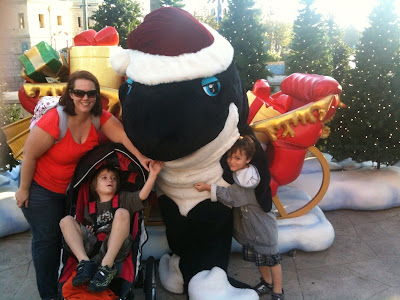
The holiday photo with Shamu...
.jpg) Jacob in conversation with Zap and his elf friend. This was hysterical. They were street performing elves in the waterfront area and I think Jacob spent 20 minutes with Zap, just talking to him. It was just kind of amazing. Jacob still talks about him, asking if he's coming for Christmas. Forget Santa, it's all Zap now. Whoever this guy was, he is amazing. If you stumble across this blog, thank you for making my kid feel so special!
Jacob in conversation with Zap and his elf friend. This was hysterical. They were street performing elves in the waterfront area and I think Jacob spent 20 minutes with Zap, just talking to him. It was just kind of amazing. Jacob still talks about him, asking if he's coming for Christmas. Forget Santa, it's all Zap now. Whoever this guy was, he is amazing. If you stumble across this blog, thank you for making my kid feel so special!
.jpg)
Jacob in the tank in the new Manta exhibit, under the coaster. Kind of cool.
.jpg)
The holiday photo with Shamu...
.jpg) Jacob in conversation with Zap and his elf friend. This was hysterical. They were street performing elves in the waterfront area and I think Jacob spent 20 minutes with Zap, just talking to him. It was just kind of amazing. Jacob still talks about him, asking if he's coming for Christmas. Forget Santa, it's all Zap now. Whoever this guy was, he is amazing. If you stumble across this blog, thank you for making my kid feel so special!
Jacob in conversation with Zap and his elf friend. This was hysterical. They were street performing elves in the waterfront area and I think Jacob spent 20 minutes with Zap, just talking to him. It was just kind of amazing. Jacob still talks about him, asking if he's coming for Christmas. Forget Santa, it's all Zap now. Whoever this guy was, he is amazing. If you stumble across this blog, thank you for making my kid feel so special!.jpg)
Jacob in the tank in the new Manta exhibit, under the coaster. Kind of cool.
More Universal Island of Adventure Photos
.jpg)
The Fantastic Car...
.jpg)
Jimmy wanting no part of the Spiderman picture.
Subscribe to:
Posts (Atom)